We first seek an integration factor, I ( s ) I(s) I ( s ) (?? ) as:
I ( s ) d u d s + I ′ ( s ) d u d s = I ( s ) 2 G M ( r s u m m i t − ∫ 0 s sin θ ( σ ) d σ ) 2 [ sin θ ( s ) − C r r cos θ ( s ) ] . \begin{aligned} I(s) \dfrac{du}{ds} + I'(s)\dfrac{du}{ds} &= I(s)\dfrac{2GM}{\left(r_{\mathrm{summit}} - \int_0^s \sin{\theta(\sigma)}d\sigma\right)^2} \left[\sin{\theta(s)}-C_{rr}\cos{\theta(s)}\right]. \end{aligned} I ( s ) d s d u + I ′ ( s ) d s d u = I ( s ) ( r s u m m i t − ∫ 0 s sin θ ( σ ) d σ ) 2 2 G M [ sin θ ( s ) − C r r cos θ ( s ) ] . Hence I ′ ( s ) I'(s) I ′ ( s ) I ( s ) ρ C D A m I(s)\dfrac{\rho C_D A}{m} I ( s ) m ρ C D A
I ( s ) = e ∫ 0 s ρ C D A m d s = e ρ C D A s m . \begin{aligned} I(s)&=e^{\int_0^s \frac{\rho C_D A}{m}ds} \\ &=e^{\frac{\rho C_D As}{m}}. \end{aligned} I ( s ) = e ∫ 0 s m ρ C D A d s = e m ρ C D A s . We can replace the left-hand side with d d s [ I ( s ) u ( s ) ] \dfrac{d}{ds}\left[I(s)u(s)\right] d s d [ I ( s ) u ( s ) ]
d d s [ I ( s ) u ( s ) ] = I ( s ) 2 G M ( r s u m m i t − ∫ 0 s sin θ ( σ ) d σ ) 2 [ sin θ ( s ) − C r r cos θ ( s ) ] . \begin{aligned} \dfrac{d}{ds}\left[I(s)u(s)\right] &= I(s)\dfrac{2GM}{\left(r_{\mathrm{summit}} - \int_0^s \sin{\theta(\sigma)}d\sigma\right)^2} \left[\sin{\theta(s)}-C_{rr}\cos{\theta(s)}\right]. \end{aligned} d s d [ I ( s ) u ( s ) ] = I ( s ) ( r s u m m i t − ∫ 0 s sin θ ( σ ) d σ ) 2 2 G M [ sin θ ( s ) − C r r cos θ ( s ) ] . Therefore Equation (0 ) becomes:
d d s [ e ρ C D A s m u ( s ) ] = 2 G M e ρ C D A s m sin θ ( s ) − C r r cos θ ( s ) ( r s u m m i t − ∫ 0 s sin θ ( σ ) d σ ) 2 . \begin{aligned} \dfrac{d}{ds}\left[e^{\frac{\rho C_D As}{m}}u(s)\right] &= 2GMe^{\frac{\rho C_D As}{m}}\dfrac{\sin{\theta(s)}-C_{rr}\cos{\theta(s)}}{\left(r_{\mathrm{summit}} - \int_0^s \sin{\theta(\sigma)}d\sigma\right)^2}. \end{aligned} d s d [ e m ρ C D A s u ( s ) ] = 2 G M e m ρ C D A s ( r s u m m i t − ∫ 0 s sin θ ( σ ) d σ ) 2 sin θ ( s ) − C r r cos θ ( s ) . Integrating both sides of Equation (1 ) from 0 to s s s s s s σ \sigma σ σ \sigma σ ξ \xi ξ
e ρ C D A s m u ( s ) − e 0 u ( 0 ) = 2 G M ∫ 0 s e ρ C D A σ m sin θ ( σ ) − C r r cos θ ( σ ) ( r s u m m i t − ∫ 0 σ sin θ ( ξ ) d ξ ) 2 d σ . \begin{aligned} e^{\frac{\rho C_D As}{m}}u(s)-e^0 u(0) &= 2GM\int_0^s e^{\frac{\rho C_D A\sigma}{m}}\dfrac{\sin{\theta(\sigma)}-C_{rr}\cos{\theta(\sigma)}}{\left(r_{\mathrm{summit}} - \int_0^{\sigma} \sin{\theta(\xi)}d\xi\right)^2} d\sigma. \end{aligned} e m ρ C D A s u ( s ) − e 0 u ( 0 ) = 2 G M ∫ 0 s e m ρ C D A σ ( r s u m m i t − ∫ 0 σ sin θ ( ξ ) d ξ ) 2 sin θ ( σ ) − C r r cos θ ( σ ) d σ . The trike's initial velocity is assumed to be zero, hence u ( 0 ) = 0 u(0)=0 u ( 0 ) = 0
e ρ C D A s m u ( s ) = 2 G M ∫ 0 s e ρ C D A σ m sin θ ( σ ) − C r r cos θ ( σ ) ( r s u m m i t − ∫ 0 σ sin θ ( ξ ) d ξ ) 2 d σ . \begin{aligned} e^{\frac{\rho C_D As}{m}}u(s) &= 2GM\int_0^s e^{\frac{\rho C_D A\sigma}{m}}\dfrac{\sin{\theta(\sigma)}-C_{rr}\cos{\theta(\sigma)}}{\left(r_{\mathrm{summit}} - \int_0^{\sigma} \sin{\theta(\xi)}d\xi\right)^2} d\sigma. \end{aligned} e m ρ C D A s u ( s ) = 2 G M ∫ 0 s e m ρ C D A σ ( r s u m m i t − ∫ 0 σ sin θ ( ξ ) d ξ ) 2 sin θ ( σ ) − C r r cos θ ( σ ) d σ . Multiplying by e − ρ C D A s m e^{-\frac{\rho C_D As}{m}} e − m ρ C D A s
u ( s ) = 2 G M e − ρ C D A s m ∫ 0 s e ρ C D A σ m sin θ ( σ ) − C r r cos θ ( σ ) ( r s u m m i t − ∫ 0 σ sin θ ( ξ ) d ξ ) 2 d σ . \begin{aligned} u(s) &= 2GMe^{-\frac{\rho C_D As}{m}}\int_0^s e^{\frac{\rho C_D A\sigma}{m}}\dfrac{\sin{\theta(\sigma)}-C_{rr}\cos{\theta(\sigma)}}{\left(r_{\mathrm{summit}} - \int_0^{\sigma} \sin{\theta(\xi)}d\xi\right)^2} d\sigma. \end{aligned} u ( s ) = 2 G M e − m ρ C D A s ∫ 0 s e m ρ C D A σ ( r s u m m i t − ∫ 0 σ sin θ ( ξ ) d ξ ) 2 sin θ ( σ ) − C r r cos θ ( σ ) d σ . Square rooting u u u
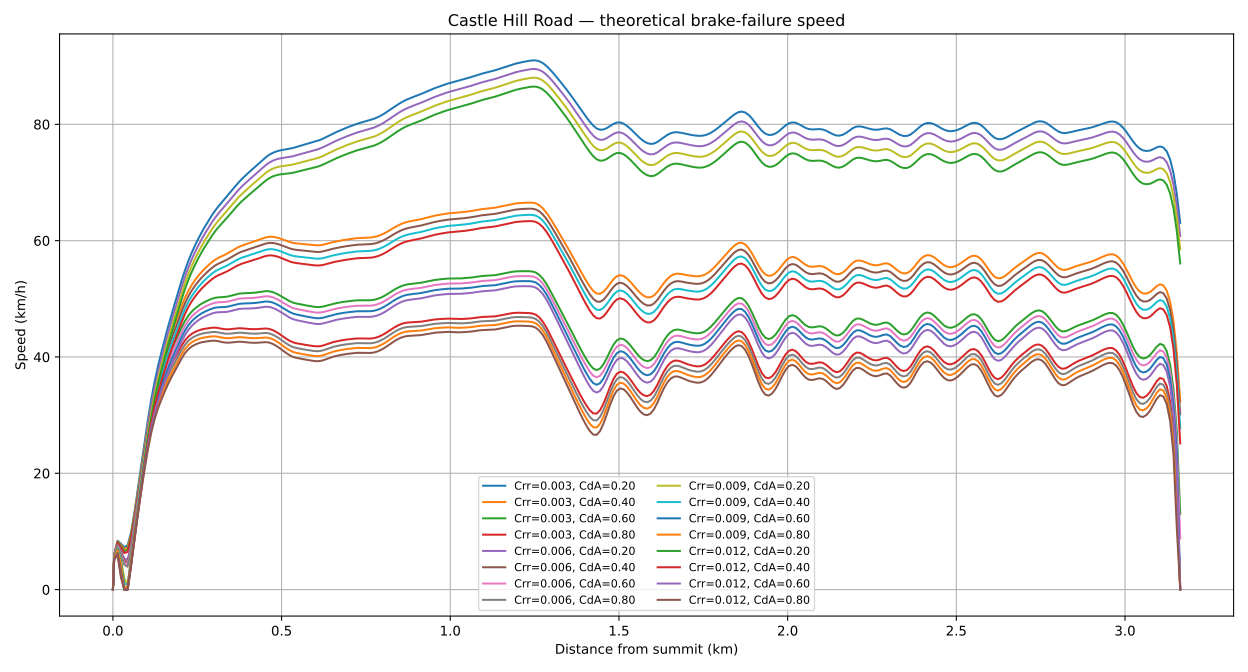
v ( s ) = 2 G M e − ρ C D A s m ∫ 0 s e ρ C D A σ m sin θ ( σ ) − C r r cos θ ( σ ) ( r s u m m i t − ∫ 0 σ sin θ ( ξ ) d ξ ) 2 d σ . \begin{aligned} v(s) &= \sqrt{2GMe^{-\frac{\rho C_D As}{m}}\int_0^s e^{\frac{\rho C_D A\sigma}{m}}\dfrac{\sin{\theta(\sigma)}-C_{rr} \cos{\theta(\sigma)}}{\left(r_{\mathrm{summit}}-\int_0^\sigma \sin{\theta(\xi)} d\xi\right)^2} d \sigma}. \end{aligned} v ( s ) = 2 G M e − m ρ C D A s ∫ 0 s e m ρ C D A σ ( r s u m m i t − ∫ 0 σ sin θ ( ξ ) d ξ ) 2 sin θ ( σ ) − C r r cos θ ( σ ) d σ . Below are the velocities achieved in the above model for various C D A C_D A C D A C r r C_{rr} C r r
Velocity while descending Castle Hill, assuming non-constant gravity.