We first seek an integration factor, I ( s ) I(s) I ( s ) (?? ) as:
I ( s ) d u d s + I ′ ( s ) d u d s = 2 g I ( s ) ( sin θ ( s ) − C r r cos θ ( s ) ) \begin{aligned} I(s) \dfrac{du}{ds} + I'(s)\dfrac{du}{ds} &= 2gI(s)(\sin{\theta(s)} - C_{rr} \cos{\theta(s)}) \end{aligned} I ( s ) d s d u + I ′ ( s ) d s d u = 2 g I ( s ) ( sin θ ( s ) − C r r cos θ ( s ) ) This implies that I ′ ( s ) = I ( s ) ρ C D A m I'(s)=I(s)\dfrac{\rho C_D A}{m} I ′ ( s ) = I ( s ) m ρ C D A
I ( s ) = e ∫ 0 s ρ C D A m d σ = e ρ C D A s m . \begin{aligned} I(s)&=e^{\int_0^s \frac{\rho C_D A}{m}d \sigma} \\ &= e^{\frac{\rho C_D As}{m}}. \end{aligned} I ( s ) = e ∫ 0 s m ρ C D A d σ = e m ρ C D A s . Multiplying Equation (?? ) by our integration factor yields:
e ρ C D A s m d u d s + e ρ C D A s m ρ C D A u m = 2 g e ρ C D A s m ( sin θ ( s ) − C r r cos θ ( s ) ) . \begin{aligned} e^{\frac{\rho C_D As}{m}}\dfrac{du}{ds} + e^{\frac{\rho C_D As}{m}}\dfrac{\rho C_D A u}{m} &= 2ge^{\frac{\rho C_D As}{m}}(\sin{\theta(s)} - C_{rr} \cos{\theta(s)}). \end{aligned} e m ρ C D A s d s d u + e m ρ C D A s m ρ C D A u = 2 g e m ρ C D A s ( sin θ ( s ) − C r r cos θ ( s ) ) . The left-hand side is the derivative of I ( s ) u ( s ) I(s)u(s) I ( s ) u ( s ) s s s
d d s [ e ρ C D A s m u ( s ) ] = 2 g e ρ C D A s m ( sin θ ( s ) − C r r cos θ ( s ) ) . \begin{aligned} \dfrac{d}{ds}\left[e^{\frac{\rho C_D As}{m}}u(s)\right] &= 2ge^{\frac{\rho C_D As}{m}}(\sin{\theta(s)} - C_{rr} \cos{\theta(s)}). \end{aligned} d s d [ e m ρ C D A s u ( s ) ] = 2 g e m ρ C D A s ( sin θ ( s ) − C r r cos θ ( s ) ) . Integrating both sides with respect to s s s σ \sigma σ s s s
e ρ C D A s m u ( s ) − e 0 u ( 0 ) = 2 g ∫ 0 s e ρ C D A σ m ( sin θ ( σ ) − C r r cos θ ( σ ) ) d σ . \begin{aligned} e^{\frac{\rho C_D As}{m}}u(s) - e^{0}u(0) &= 2g\int_0^s e^{\frac{\rho C_D A\sigma}{m}}(\sin{\theta(\sigma)} - C_{rr} \cos{\theta(\sigma)})d\sigma. \end{aligned} e m ρ C D A s u ( s ) − e 0 u ( 0 ) = 2 g ∫ 0 s e m ρ C D A σ ( sin θ ( σ ) − C r r cos θ ( σ ) ) d σ . Since the trike starts at zero velocity u ( 0 ) = 0 u(0)=0 u ( 0 ) = 0
e ρ C D A s m u ( s ) = 2 g ∫ 0 s e ρ C D A σ m ( sin θ ( σ ) − C r r cos θ ( σ ) ) d σ . \begin{aligned} e^{\frac{\rho C_D As}{m}}u(s) &= 2g\int_0^s e^{\frac{\rho C_D A\sigma}{m}}(\sin{\theta(\sigma)} - C_{rr} \cos{\theta(\sigma)})d\sigma. \end{aligned} e m ρ C D A s u ( s ) = 2 g ∫ 0 s e m ρ C D A σ ( sin θ ( σ ) − C r r cos θ ( σ ) ) d σ . Multiplying by e − ρ C D A s m e^{-\frac{\rho C_D As}{m}} e − m ρ C D A s
u ( s ) = 2 g e − ρ C D A s m ∫ 0 s e ρ C D A σ m ( sin θ ( σ ) − C r r cos θ ( σ ) ) d σ . \begin{aligned} u(s) = 2ge^{-\frac{\rho C_D As}{m}}\int_0^s e^{\frac{\rho C_D A\sigma}{m}}(\sin{\theta(\sigma)}-C_{rr} \cos{\theta(\sigma)})d \sigma. \end{aligned} u ( s ) = 2 g e − m ρ C D A s ∫ 0 s e m ρ C D A σ ( sin θ ( σ ) − C r r cos θ ( σ ) ) d σ . Square rooting we obtain the velocity:
v ( s ) = 2 g e − ρ C D A s m ∫ 0 s e ρ C D A σ m ( sin θ ( σ ) − C r r cos θ ( σ ) ) d σ . \begin{aligned} v(s) &= \sqrt{2ge^{-\frac{\rho C_D As}{m}}\int_0^s e^{\frac{\rho C_D A\sigma}{m}}(\sin{\theta(\sigma)}-C_{rr} \cos{\theta(\sigma)})d \sigma}. \end{aligned} v ( s ) = 2 g e − m ρ C D A s ∫ 0 s e m ρ C D A σ ( sin θ ( σ ) − C r r cos θ ( σ ) ) d σ . We neglected the negative possibility because velocity is positive in the downhill direction, which is the only direction the trike will go when under the action of gravity.
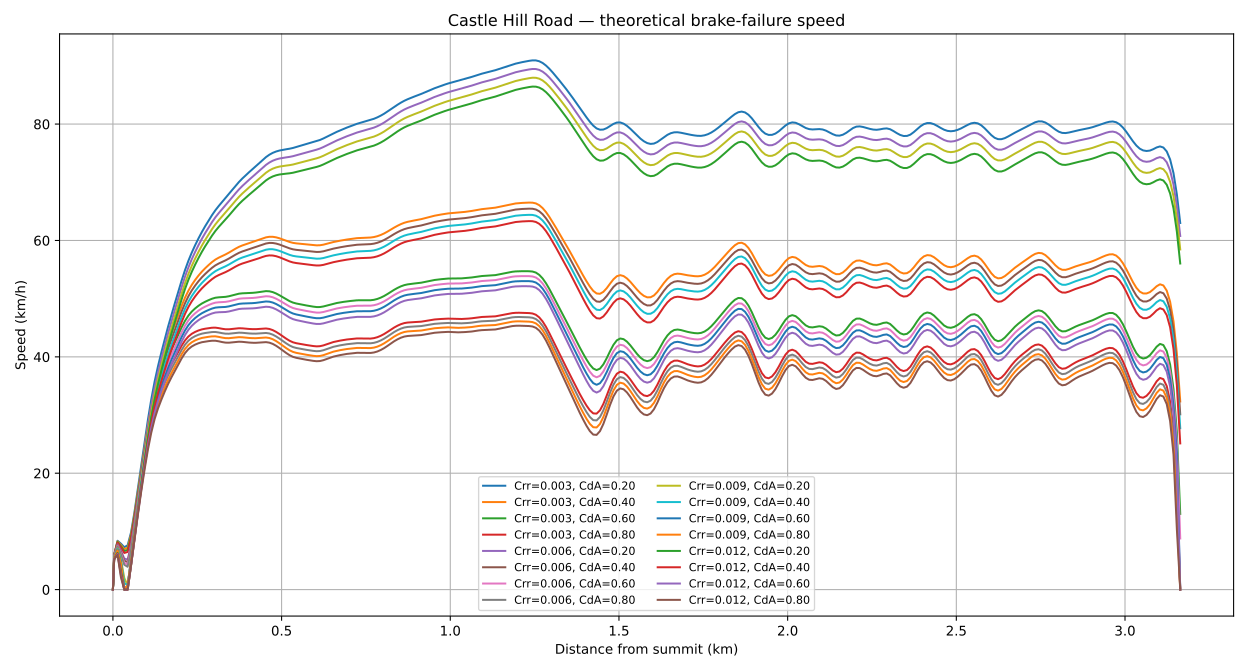
Below are the velocities achieved in the above model for various C D A C_D A C D A C r r C_{rr} C r r θ ( s ) \theta(s) θ ( s )
Velocity while descending Castle Hill, assuming constant gravity.