Tag

With rolling resistance and air resistance

More realistically, however, we would expect there to be non-conservative forces acting on the trike, such as rolling resistance and aerodynamic drag. When these forces act upon the trike a simple analytical solution becomes less easy to obtain, at least if the angle of descent is allowed to not remain constant. To parametize the problem we will use an independent variable ss that will be distance, in metres, from the summit of the hill or mountain. We will assume this mountain has a road that we are travelling down and ss is the distance from the summit along this road.

Constant gravity

We will first assume that the variation in gravitational acceleration between the base and summit of the hill or mountain is negligible and derive the equation of motion based on this assumption.

Formulating the Lagrangian

The first step in deriving the equation of motion is to determine the Lagrangian of the system. The Lagrangian contains both the kinetic and potential energy of the system and hence both will be calculated next.

Kinetic energy

Substituting: v=s˙\begin{aligned} v=\dot{s} \end{aligned} where s˙=dsdt\dot{s}=\dfrac{ds}{dt} is the trike's velocity in m⋅s−1\mathrm{m}\cdot \mathrm{s}^{-1} into Equation (??) yields: T=ms˙22.\begin{aligned} T=\dfrac{m\dot{s}^2}{2}. \end{aligned}

Potential energy

The potential energy term will only include the conservative force of gravitation. To compute it, we need to be able to formulate the height of the trike above sea level in terms of ss. If we have inclination/declination angle data for the hill in question, let us define θ(s)\theta(s) as the declination angle (positive when downhill) at ss metres from the summit. If we form an infinitesimal triangle on the hill/mountain, we will see that dh=−dssin⁡θdh = -d s \sin{\theta} and hence: dhds=−sin⁡θ(s).\begin{aligned} \dfrac{dh}{ds} &= -\sin{\theta(s)}. \end{aligned} Integrating from the summit, we obtain that: h(s)=hsummit−∫0ssin⁡θ(σ)dσ.\begin{aligned} h(s) &= h_{\mathrm{summit}} - \int_{0}^s \sin{\theta(\sigma)}d\sigma. \end{aligned} Where hsummith_{\mathrm{summit}} is the height of the hill/mountain, or rather its tallest point accessible by road, and we use σ\sigma as a dummy (integration) variable for distance from the summit.

Hence if gravitational acceleration can be assumed to be constant: V=mg(hsummit−∫0ssin⁡θ(σ)dσ).\begin{aligned} V &= mg\left(h_{\mathrm{summit}} - \int_0^s \sin{\theta(\sigma)}d\sigma\right). \end{aligned}

Final Lagrangian

The Lagrangian is, by definition: L=T−V.\begin{aligned} L &= T - V. \end{aligned}

Substituting Equations (??) and (5) into Equation (6). Therefore our Lagrangian is: L=ms˙22−mg(hsummit−∫0ssin⁡θ(σ)dσ).\begin{aligned} L &= \dfrac{m\dot{s}^2}{2} - mg\left(h_{\mathrm{summit}} - \int_0^s \sin{\theta(\sigma)}d\sigma\right). \end{aligned}

Non-conservative forces

It is important to note, however, that nonconservative forces — such as air resistance and rolling resistance — are a major factor in determining the speed of a tricycle going downhill. To account for these effects, we need to calculate generalized forces. Fortunately, since our problem only has a single independent variable — that of distance from the summit — calculating the generalized forces should be straightforward.

Rolling resistance is proportional to the normal force. The normal force could be calculated as: N=mgcos⁡θ(s).\begin{aligned} N=mg\cos{\theta(s)}. \end{aligned} The rolling resistance force is defined as:

Fr=CrrN.\begin{aligned} F_r &= C_{rr}N. \end{aligned}
Where CrrC_{rr} is the coefficient of rolling resistance. Substituting Equation (8) into Equation (8) yields: Fr=mgCrrcos⁡θ(s).\begin{aligned} F_r &= mgC_{rr}\cos{\theta(s)}. \end{aligned} This force directly opposes motion in the direction of ss.

As for air resistance (or drag): FD=ρCDAv22.\begin{aligned} F_D &= \dfrac{\rho C_D A v^2}{2}. \end{aligned} Substituting Equation (1) into Equation (10) yields: FD=ρCDAs˙22.\begin{aligned} F_D &= \dfrac{\rho C_D A \dot{s}^2}{2}. \end{aligned} Where ρ\rho is air density in kg⋅m−3\mathrm{kg} \cdot \mathrm{m}^{-3}, CDC_D is a dimensionless drag coefficient, AA is the cross sectional surface area (in m2m^2) that the area acts on. This is also in the opposite direction to motion. Hence the generalized non-conservative forces acting on our tricycle would be:

Qs=−mgCrrcos⁡θ(s)−ρCDAs˙22.\begin{aligned} Q_s &= -mgC_{rr} \cos{\theta(s)} - \dfrac{\rho C_D A\dot{s}^2}{2}. \end{aligned}

Euler-Lagrange equation with non-conservative forces

The Euler-Lagrange equation with dissipative forces in the ss coordinate is: ddt∂L∂s˙−∂L∂s=Qs.\begin{aligned} \dfrac{d}{dt}\dfrac{\partial L}{\partial \dot{s}} - \dfrac{\partial L}{\partial s} &= Q_s. \end{aligned} The left-hand side of Equation (12) can also be denoted as δSδs\dfrac{\delta S}{\delta s}, the functional derivative of SS with respect to ss. SS is the action and is defined by:

S=∫t0tfL(s,s˙,t)dt\begin{aligned} S=\int_{t_0}^{t_f} L(s, \dot{s}, t) dt \end{aligned}
where t0t_0 is the starting time and tft_f is the finishing time. First, we shall calculate ∂L∂s˙\dfrac{\partial L}{\partial \dot{s}}, the canonical momentum:
∂L∂s˙=ms˙.\begin{aligned} \dfrac{\partial L}{\partial \dot{s}} &= m\dot{s}. \end{aligned}
Hence: ddt∂L∂s˙=ms¨.\begin{aligned} \dfrac{d}{dt}\dfrac{\partial L}{\partial \dot{s}} &= m\ddot{s}. \end{aligned} As for the second term in Equation (12), it is:
∂L∂s=mgsin⁡θ(s).\begin{aligned} \dfrac{\partial L}{\partial s} &= mg\sin{\theta(s)}. \end{aligned}
So the functional derivative is therefore:
δSδs=ms¨−mgsin⁡θ(s).\begin{aligned} \dfrac{\delta S}{\delta s} &= m\ddot{s} - mg\sin{\theta(s)}. \end{aligned}
Hence Equation (12) becomes:
ms¨−mgsin⁡θ(s)=−mgCrrcos⁡θ(s)−ρCDAs˙22.\begin{aligned} m\ddot{s} - mg\sin{\theta(s)} &= -mgC_{rr} \cos{\theta(s)} - \dfrac{\rho C_D A\dot{s}^2}{2}. \end{aligned}
Rearranging and factorizing yields:
ms¨=mg(sin⁡θ(s)+Crrcos⁡θ(s))−ρCDAs˙22.\begin{aligned} m\ddot{s} &= mg(\sin{\theta(s)}+C_{rr}\cos{\theta(s)})-\dfrac{\rho C_D A\dot{s}^2}{2}. \end{aligned}
Dividing both sides by mm yields: s¨=g(sin⁡θ(s)+Crrcos⁡θ(s))−ρCDAs˙22m\begin{aligned} \ddot{s} &= g(\sin{\theta(s)}+C_{rr}\cos{\theta(s)})-\dfrac{\rho C_D A\dot{s}^2}{2m} \end{aligned} assuming constant gravitational acceleration.

Simplification to first order

s¨=ds˙dsdsdt=dsdtds˙ds=s˙ds˙ds.\begin{aligned} \ddot{s} &= \dfrac{d\dot{s}}{ds} \dfrac{ds}{dt} \\ &= \dfrac{ds}{dt} \dfrac{d\dot{s}}{ds} \\ &= \dot{s} \dfrac{d\dot{s}}{ds}. \end{aligned}
Hence Equation (14) becomes, after dividing by mm:
s˙ds˙ds=g(sin⁡θ(s)−Crrcos⁡θ(s))−ρCDAs˙22m.\begin{aligned} \dot{s} \dfrac{d\dot{s}}{ds} &= g(\sin{\theta(s)} - C_{rr} \cos{\theta(s)}) - \dfrac{\rho C_D A\dot{s}^2}{2m}. \end{aligned}
Let u=s˙2u=\dot{s}^2, then:
duds=d(s˙2)ds\begin{aligned} \dfrac{du}{ds} &= \dfrac{d(\dot{s}^2)}{ds} \end{aligned}
Hence by the chain rule:
duds=2s˙ds˙ds.\begin{aligned} \dfrac{du}{ds} &= 2\dot{s}\dfrac{d\dot{s}}{ds}. \end{aligned}
Consequently:
12duds=g(sin⁡θ(s)−Crrcos⁡θ(s))−ρCDAu2m.\begin{aligned} \dfrac{1}{2}\dfrac{du}{ds} &= g(\sin{\theta(s)} - C_{rr} \cos{\theta(s)}) - \dfrac{\rho C_D A u}{2m}. \end{aligned}
Multiplying both sides by 2 yields:
duds=2g(sin⁡θ(s)−Crrcos⁡θ(s))−ρCDAum.\begin{aligned} \dfrac{du}{ds} &= 2g(\sin{\theta(s)} - C_{rr} \cos{\theta(s)}) - \dfrac{\rho C_D A u}{m}. \end{aligned}
Adding the uu term to the left-hand side: duds+ρCDAum=2g(sin⁡θ(s)−Crrcos⁡θ(s)).\begin{aligned} \dfrac{du}{ds} + \dfrac{\rho C_D A u}{m} &= 2g(\sin{\theta(s)} - C_{rr} \cos{\theta(s)}). \end{aligned}

Solution

We first seek an integration factor, I(s)I(s), so that we can re-write Equation (25) as:

I(s)duds+I′(s)duds=2gI(s)(sin⁡θ(s)−Crrcos⁡θ(s))\begin{aligned} I(s) \dfrac{du}{ds} + I'(s)\dfrac{du}{ds} &= 2gI(s)(\sin{\theta(s)} - C_{rr} \cos{\theta(s)}) \end{aligned}
This implies that I′(s)=I(s)ρCDAmI'(s)=I(s)\dfrac{\rho C_D A}{m} hence:
I(s)=e∫0sρCDAmdσ=eρCDAsm.\begin{aligned} I(s)&=e^{\int_0^s \frac{\rho C_D A}{m}d \sigma} \\ &= e^{\frac{\rho C_D As}{m}}. \end{aligned}
Multiplying Equation (15) by our integration factor yields:
eρCDAsmduds+eρCDAsmρCDAum=2geρCDAsm(sin⁡θ(s)−Crrcos⁡θ(s)).\begin{aligned} e^{\frac{\rho C_D As}{m}}\dfrac{du}{ds} + e^{\frac{\rho C_D As}{m}}\dfrac{\rho C_D A u}{m} &= 2ge^{\frac{\rho C_D As}{m}}(\sin{\theta(s)} - C_{rr} \cos{\theta(s)}). \end{aligned}
The left-hand side is the derivative of I(s)u(s)I(s)u(s) with respect to ss:
dds[eρCDAsmu(s)]=2geρCDAsm(sin⁡θ(s)−Crrcos⁡θ(s)).\begin{aligned} \dfrac{d}{ds}\left[e^{\frac{\rho C_D As}{m}}u(s)\right] &= 2ge^{\frac{\rho C_D As}{m}}(\sin{\theta(s)} - C_{rr} \cos{\theta(s)}). \end{aligned}
Integrating both sides with respect to ss (using the dummy variable of integration σ\sigma) from 0 to ss yields:
eρCDAsmu(s)−e0u(0)=2g∫0seρCDAσm(sin⁡θ(σ)−Crrcos⁡θ(σ))dσ.\begin{aligned} e^{\frac{\rho C_D As}{m}}u(s) - e^{0}u(0) &= 2g\int_0^s e^{\frac{\rho C_D A\sigma}{m}}(\sin{\theta(\sigma)} - C_{rr} \cos{\theta(\sigma)})d\sigma. \end{aligned}
Since the trike starts at zero velocity u(0)=0u(0)=0. Hence we have: eρCDAsmu(s)=2g∫0seρCDAσm(sin⁡θ(σ)−Crrcos⁡θ(σ))dσ.\begin{aligned} e^{\frac{\rho C_D As}{m}}u(s) &= 2g\int_0^s e^{\frac{\rho C_D A\sigma}{m}}(\sin{\theta(\sigma)} - C_{rr} \cos{\theta(\sigma)})d\sigma. \end{aligned} Multiplying by e−ρCDAsme^{-\frac{\rho C_D As}{m}} yields: u(s)=2ge−ρCDAsm∫0seρCDAσm(sin⁡θ(σ)−Crrcos⁡θ(σ))dσ.\begin{aligned} u(s) = 2ge^{-\frac{\rho C_D As}{m}}\int_0^s e^{\frac{\rho C_D A\sigma}{m}}(\sin{\theta(\sigma)}-C_{rr} \cos{\theta(\sigma)})d \sigma. \end{aligned}

Square rooting we obtain the velocity: v(s)=2ge−ρCDAsm∫0seρCDAσm(sin⁡θ(σ)−Crrcos⁡θ(σ))dσ.\begin{aligned} v(s) &= \sqrt{2ge^{-\frac{\rho C_D As}{m}}\int_0^s e^{\frac{\rho C_D A\sigma}{m}}(\sin{\theta(\sigma)}-C_{rr} \cos{\theta(\sigma)})d \sigma}. \end{aligned} We neglected the negative possibility because velocity is positive in the downhill direction, which is the only direction the trike will go when under the action of gravity.

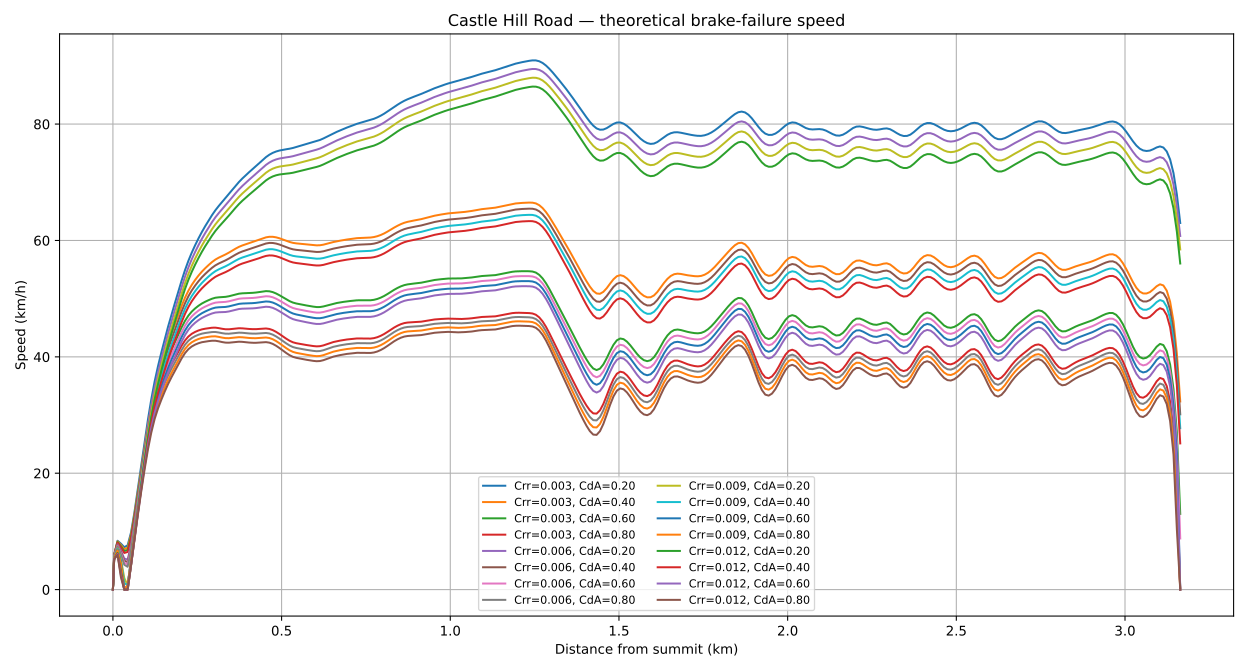
Below are the velocities achieved in the above model for various CDAC_D A and CrrC_{rr} values when descending Castle Hill. The simulation did not end at 0 metres above sea level; it ended at about 36 metres above sea level, which is approximately at the high end of Gregory Street. θ(s)\theta(s) values were calculated from QldDem data on elevation.

Velocity while descending Castle Hill, assuming constant gravity.

Non-constant gravity

Gravitational acceleration depends on the distance from the centre of the source of gravity, so there is some variation in gravitational acceleration between the base and summit of hills and mountains although it is minor. In this section, the equation of motion will be derived while accounting for this variability.

Formulating the Lagrangian

The kinetic energy we use when studying non-constant gravity is the same as before. Consequently, Equation (13) is also true for this Lagrangian.

Potential energy

If we cannot assume constant gravity, then: V=GMm(rbase+h(s))−GMmrsummit.\begin{aligned} V &=\dfrac{GMm}{(r_{\mathrm{base}} + h(s))} - \dfrac{GMm}{r_{\mathrm{summit}}}. \end{aligned} Factorizing: V=GMm((rbase+h(s))−1−rsummit−1).\begin{aligned} V &= GMm\left((r_{\mathrm{base}} + h(s))^{-1} - r_{\mathrm{summit}}^{-1}\right). \end{aligned} Where GG is the gravitational constant and MM is the mass of the Earth.

Substituting Equation (4) into Equation (20) yields:

V=GMm[(rsummit−∫0ssin⁡θ(σ)dσ)−1−rsummit−1].\begin{aligned} V &= GMm\left[\left(r_{\mathrm{summit}} - \int_0^s \sin{\theta(\sigma)}d\sigma\right)^{-1}-r_{\mathrm{summit}}^{-1}\right]. \end{aligned}

Final Lagrangian

The Lagrangian of our system is therefore:

L=ms˙22−GMm[(rsummit−∫0ssin⁡θ(σ)dσ)−1−rsummit−1].\begin{aligned} L &= \dfrac{m\dot{s}^2}{2} - GMm\left[\left(r_{\mathrm{summit}} - \int_0^s \sin{\theta(\sigma)}d\sigma\right)^{-1}-r_{\mathrm{summit}}^{-1}\right]. \end{aligned}

Non-conservative forces

If gravity cannot be assumed to be constant then:

g=GM(rsummit−∫0ssin⁡θ(σ)dσ)2.\begin{aligned} g=\dfrac{GM}{\left(r_{\mathrm{summit}} - \int_0^s \sin{\theta(\sigma)}d\sigma\right)^2}. \end{aligned}
Substituting Equation (20) into Equation (9) yields: Fr=GMmCrrcos⁡θ(s)(rsummit−∫0ssin⁡θ(σ)dσ)2\begin{aligned} F_r &= \dfrac{GMmC_{rr}\cos{\theta(s)}}{\left(r_{\mathrm{summit}} - \int_0^s \sin{\theta(\sigma)}d\sigma\right)^2} \end{aligned}

Computing Equation (12)

The conservative force term of the Euler-Lagrange equation is therefore: ∂L∂s=GMmsin⁡θ(s)(rsummit−∫0ssin⁡θ(σ)dσ)2.\begin{aligned} \dfrac{\partial L}{\partial s} &= \dfrac{GMm\sin{\theta(s)}}{\left(r_{\mathrm{summit}} - \int_0^s \sin{\theta(\sigma)}d\sigma\right)^2}. \end{aligned} Hence the functional derivative of SS with respect to ss is therefore:

δSδs=ms¨−GMmsin⁡θ(s)(rsummit−∫0ssin⁡θ(σ)dσ)2.\begin{aligned} \dfrac{\delta S}{\delta s} &= m\ddot{s} - \dfrac{GMm\sin{\theta(s)}}{\left(r_{\mathrm{summit}} - \int_0^s \sin{\theta(\sigma)}d\sigma\right)^2}. \end{aligned}
The time derivative of generalized momentum is the same as above. As for QsQ_s it is: Qs=−GMmCrrcos⁡θ(s)(rsummit−∫0ssin⁡θ(σ)dσ)2−ρCDAs˙22.\begin{aligned} Q_s &= -\dfrac{GMmC_{rr}\cos{\theta(s)}}{\left(r_{\mathrm{summit}} - \int_0^s \sin{\theta(\sigma)}d\sigma\right)^2} - \dfrac{\rho C_D A \dot{s}^2}{2}. \end{aligned} Substituting Equations (22) and (23) into Equation (12) yields:
ms¨−GMmsin⁡θ(s)(rsummit−∫0ssin⁡θ(σ)dσ)2=−GMmCrrcos⁡θ(s)(rsummit−∫0ssin⁡θ(σ)dσ)2−ρCDAs˙22.\begin{aligned} m\ddot{s} - \dfrac{GMm\sin{\theta(s)}}{\left(r_{\mathrm{summit}} - \int_0^s \sin{\theta(\sigma)}d\sigma\right)^2} &= -\dfrac{GMmC_{rr}\cos{\theta(s)}}{\left(r_{\mathrm{summit}} - \int_0^s \sin{\theta(\sigma)}d\sigma\right)^2} - \dfrac{\rho C_D A\dot{s}^2}{2}. \end{aligned}
Rearranging and factorizing:
ms¨=GMm(rsummit−∫0ssin⁡θ(σ)dσ)2[sin⁡θ(s)−Crrcos⁡θ(s)]−ρCDAs˙22.\begin{aligned} m\ddot{s} &= \dfrac{GMm}{\left(r_{\mathrm{summit}} - \int_0^s \sin{\theta(\sigma)}d\sigma\right)^2} \left[\sin{\theta(s)}-C_{rr}\cos{\theta(s)}\right] - \dfrac{\rho C_D A\dot{s}^2}{2}. \end{aligned}
Dividing by mm: s¨=GM(rsummit−∫0ssin⁡θ(σ)dσ)2[sin⁡θ(s)−Crrcos⁡θ(s)]−ρCDAs˙22m.\begin{aligned} \ddot{s} &= \dfrac{GM}{\left(r_{\mathrm{summit}} - \int_0^s \sin{\theta(\sigma)}d\sigma\right)^2} \left[\sin{\theta(s)}-C_{rr}\cos{\theta(s)}\right] - \dfrac{\rho C_D A\dot{s}^2}{2m}. \end{aligned}

Simplification to first order

s¨=s˙ds˙ds\ddot{s} = \dot{s} \dfrac{d\dot{s}}{ds} hence Equation (24) becomes:

s˙ds˙ds=GM(rsummit−∫0ssin⁡θ(σ)dσ)2[sin⁡θ(s)−Crrcos⁡θ(s)]−ρCDAs˙22m.\begin{aligned} \dot{s} \dfrac{d\dot{s}}{ds} &= \dfrac{GM}{\left(r_{\mathrm{summit}} - \int_0^s \sin{\theta(\sigma)}d\sigma\right)^2} \left[\sin{\theta(s)}-C_{rr}\cos{\theta(s)}\right] - \dfrac{\rho C_D A\dot{s}^2}{2m}. \end{aligned}
Letting u=s˙2u=\dot{s}^2, then duds=2s˙ds˙ds\dfrac{du}{ds} = 2\dot{s}\dfrac{d\dot{s}}{ds} and so:
12duds=GM(rsummit−∫0ssin⁡θ(σ)dσ)2[sin⁡θ(s)−Crrcos⁡θ(s)]−ρCDAu2m.\begin{aligned} \dfrac{1}{2}\dfrac{du}{ds} &= \dfrac{GM}{\left(r_{\mathrm{summit}} - \int_0^s \sin{\theta(\sigma)}d\sigma\right)^2} \left[\sin{\theta(s)}-C_{rr}\cos{\theta(s)}\right] - \dfrac{\rho C_D A u}{2m}. \end{aligned}
Multiplying both sides by 2 yields:
duds=2GM(rsummit−∫0ssin⁡θ(σ)dσ)2[sin⁡θ(s)−Crrcos⁡θ(s)]−ρCDAum.\begin{aligned} \dfrac{du}{ds} &= \dfrac{2GM}{\left(r_{\mathrm{summit}} - \int_0^s \sin{\theta(\sigma)}d\sigma\right)^2} \left[\sin{\theta(s)}-C_{rr}\cos{\theta(s)}\right] - \dfrac{\rho C_D A u}{m}. \end{aligned}
Adding the uu term to the left-hand side: duds+ρCDAmu=2GM(rsummit−∫0ssin⁡θ(σ)dσ)2[sin⁡θ(s)−Crrcos⁡θ(s)].\begin{aligned} \dfrac{du}{ds} + \dfrac{\rho C_D A}{m}u &= \dfrac{2GM}{\left(r_{\mathrm{summit}} - \int_0^s \sin{\theta(\sigma)}d\sigma\right)^2} \left[\sin{\theta(s)}-C_{rr}\cos{\theta(s)}\right]. \end{aligned}

Solution

We first seek an integration factor, I(s)I(s), so that we can re-write Equation (25) as:

I(s)duds+I′(s)duds=I(s)2GM(rsummit−∫0ssin⁡θ(σ)dσ)2[sin⁡θ(s)−Crrcos⁡θ(s)].\begin{aligned} I(s) \dfrac{du}{ds} + I'(s)\dfrac{du}{ds} &= I(s)\dfrac{2GM}{\left(r_{\mathrm{summit}} - \int_0^s \sin{\theta(\sigma)}d\sigma\right)^2} \left[\sin{\theta(s)}-C_{rr}\cos{\theta(s)}\right]. \end{aligned}
Hence I′(s)I'(s) must equal I(s)ρCDAmI(s)\dfrac{\rho C_D A}{m}, which therefore implies that
I(s)=e∫0sρCDAmds=eρCDAsm.\begin{aligned} I(s)&=e^{\int_0^s \frac{\rho C_D A}{m}ds} \\ &=e^{\frac{\rho C_D As}{m}}. \end{aligned}
We can replace the left-hand side with dds[I(s)u(s)]\dfrac{d}{ds}\left[I(s)u(s)\right] hence:
dds[I(s)u(s)]=I(s)2GM(rsummit−∫0ssin⁡θ(σ)dσ)2[sin⁡θ(s)−Crrcos⁡θ(s)].\begin{aligned} \dfrac{d}{ds}\left[I(s)u(s)\right] &= I(s)\dfrac{2GM}{\left(r_{\mathrm{summit}} - \int_0^s \sin{\theta(\sigma)}d\sigma\right)^2} \left[\sin{\theta(s)}-C_{rr}\cos{\theta(s)}\right]. \end{aligned}
Therefore Equation (25) becomes: dds[eρCDAsmu(s)]=2GMeρCDAsmsin⁡θ(s)−Crrcos⁡θ(s)(rsummit−∫0ssin⁡θ(σ)dσ)2.\begin{aligned} \dfrac{d}{ds}\left[e^{\frac{\rho C_D As}{m}}u(s)\right] &= 2GMe^{\frac{\rho C_D As}{m}}\dfrac{\sin{\theta(s)}-C_{rr}\cos{\theta(s)}}{\left(r_{\mathrm{summit}} - \int_0^s \sin{\theta(\sigma)}d\sigma\right)^2}. \end{aligned} Integrating both sides of Equation (26) from 0 to ss with respect to ss (calling it a new dummy variable σ\sigma; σ\sigma in our denominator will be renamed ξ\xi) yields: eρCDAsmu(s)−e0u(0)=2GM∫0seρCDAσmsin⁡θ(σ)−Crrcos⁡θ(σ)(rsummit−∫0σsin⁡θ(ξ)dξ)2dσ.\begin{aligned} e^{\frac{\rho C_D As}{m}}u(s)-e^0 u(0) &= 2GM\int_0^s e^{\frac{\rho C_D A\sigma}{m}}\dfrac{\sin{\theta(\sigma)}-C_{rr}\cos{\theta(\sigma)}}{\left(r_{\mathrm{summit}} - \int_0^{\sigma} \sin{\theta(\xi)}d\xi\right)^2} d\sigma. \end{aligned} The trike's initial velocity is assumed to be zero, hence u(0)=0u(0)=0:
eρCDAsmu(s)=2GM∫0seρCDAσmsin⁡θ(σ)−Crrcos⁡θ(σ)(rsummit−∫0σsin⁡θ(ξ)dξ)2dσ.\begin{aligned} e^{\frac{\rho C_D As}{m}}u(s) &= 2GM\int_0^s e^{\frac{\rho C_D A\sigma}{m}}\dfrac{\sin{\theta(\sigma)}-C_{rr}\cos{\theta(\sigma)}}{\left(r_{\mathrm{summit}} - \int_0^{\sigma} \sin{\theta(\xi)}d\xi\right)^2} d\sigma. \end{aligned}
Multiplying by e−ρCDAsme^{-\frac{\rho C_D As}{m}} yields:
u(s)=2GMe−ρCDAsm∫0seρCDAσmsin⁡θ(σ)−Crrcos⁡θ(σ)(rsummit−∫0σsin⁡θ(ξ)dξ)2dσ.\begin{aligned} u(s) &= 2GMe^{-\frac{\rho C_D As}{m}}\int_0^s e^{\frac{\rho C_D A\sigma}{m}}\dfrac{\sin{\theta(\sigma)}-C_{rr}\cos{\theta(\sigma)}}{\left(r_{\mathrm{summit}} - \int_0^{\sigma} \sin{\theta(\xi)}d\xi\right)^2} d\sigma. \end{aligned}
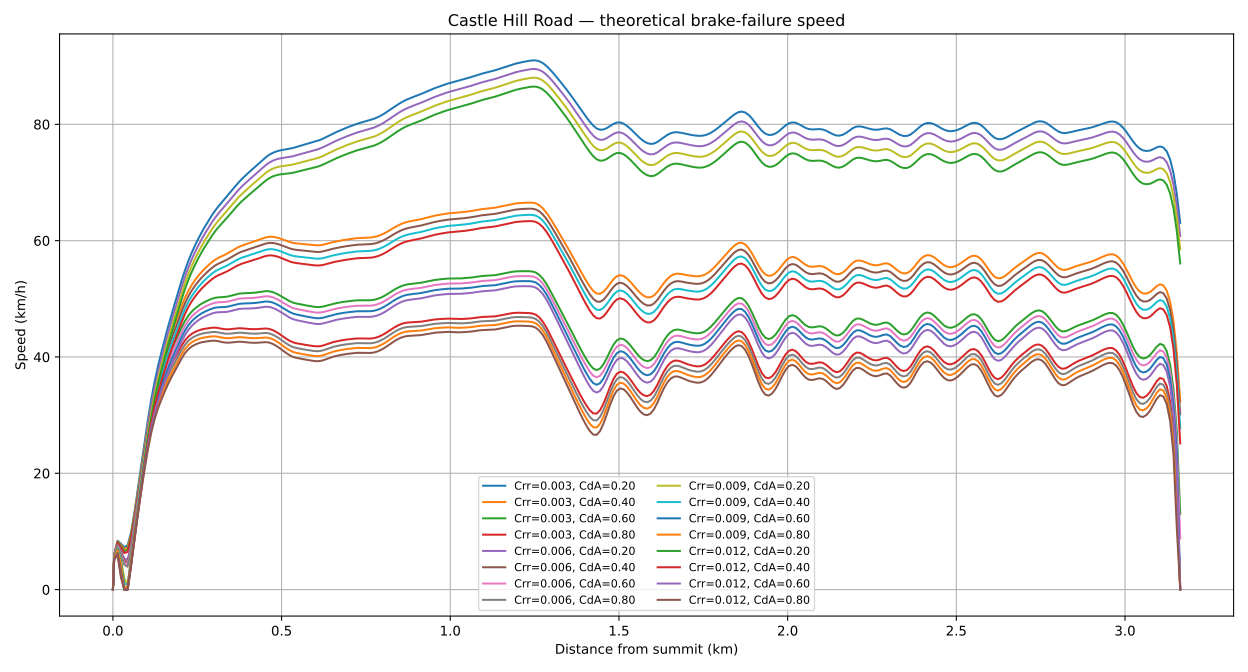
Square rooting uu to obtain velocity yields: v(s)=2GMe−ρCDAsm∫0seρCDAσmsin⁡θ(σ)−Crrcos⁡θ(σ)(rsummit−∫0σsin⁡θ(ξ)dξ)2dσ.\begin{aligned} v(s) &= \sqrt{2GMe^{-\frac{\rho C_D As}{m}}\int_0^s e^{\frac{\rho C_D A\sigma}{m}}\dfrac{\sin{\theta(\sigma)}-C_{rr} \cos{\theta(\sigma)}}{\left(r_{\mathrm{summit}}-\int_0^\sigma \sin{\theta(\xi)} d\xi\right)^2} d \sigma}. \end{aligned} Below are the velocities achieved in the above model for various CDAC_D A and CrrC_{rr} values when descending Castle Hill. The simulation did not end at 0 metres above sea level; it ended at about 36 metres above sea level, which is approximately at the high end of Gregory Street.

Velocity while descending Castle Hill, assuming non-constant gravity.